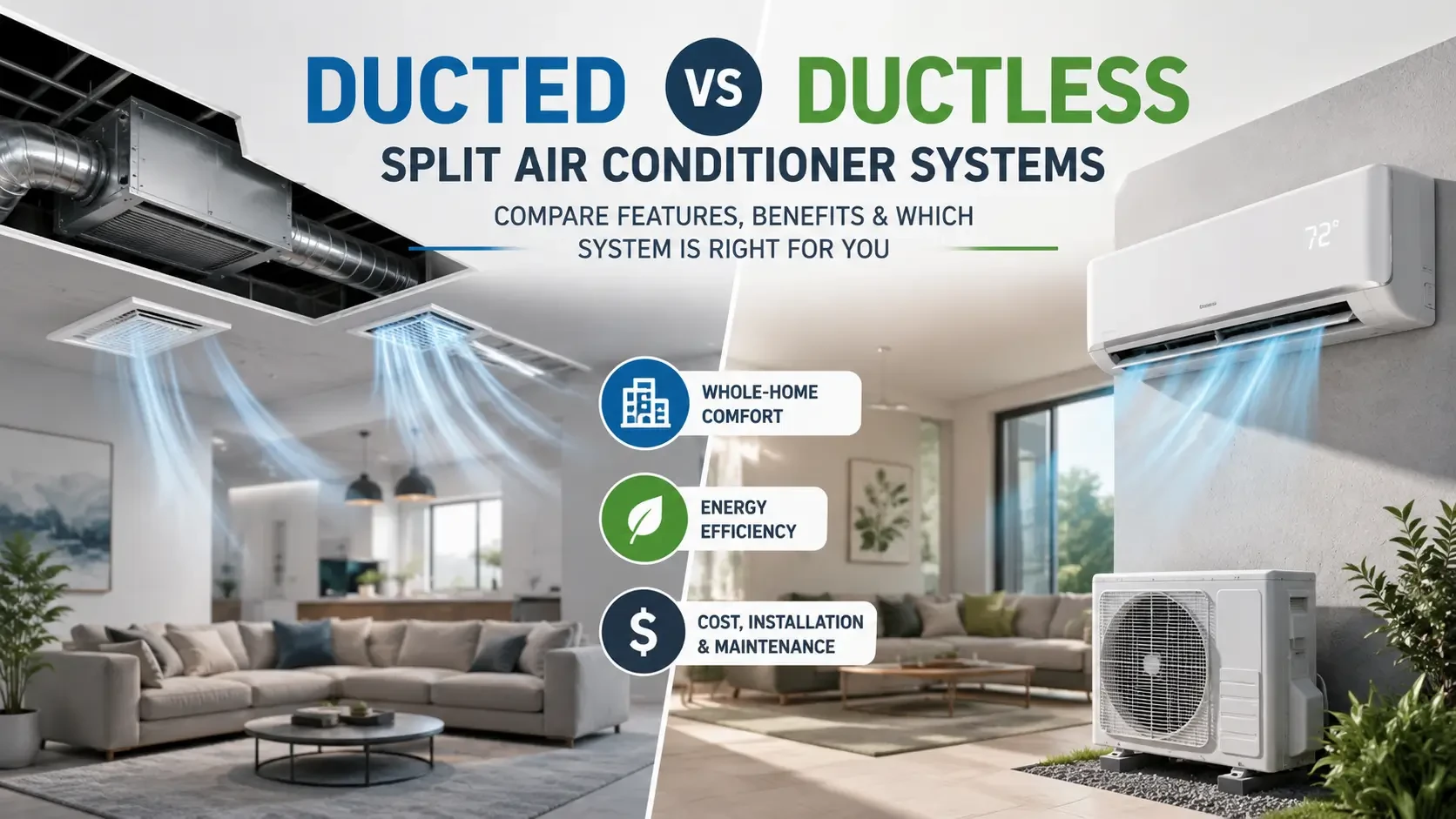
Choosing the right cooling and heating solution is one of the most important decisions you will make for a home, office, or commercial building. Two of the most common approaches are ducted systems and ductless split systems. While both deliver comfortable, controlled indoor temperatures, they differ significantly in installation, efficiency, cost, and the type of spaces they suit best.
This guide breaks down how each system works, where they excel, and how to decide which one fits your project.
What Is a Ducted Air Conditioning System?
A ducted air conditioning system distributes conditioned air through a network of ducts hidden inside ceilings, walls, or floors. A central indoor unit cools or heats the air, and that air is then pushed through the ductwork to vents (or grilles) located in each room.
Because the equipment is concealed, the only visible elements are the discreet supply and return vents. This makes ducted systems a popular choice where a clean, uniform aesthetic is a priority think high-end residences, hotels, and open-plan offices.
Key characteristics of ducted systems:
- Centralized cooling and heating from a single indoor unit
- Even temperature distribution across multiple rooms
- Minimal visual impact, with only vents on display
- Higher upfront cost and more complex installation
- Best suited to new builds or major renovations where ductwork can be installed easily
For larger buildings that require zoned control across many rooms or floors, ducted distribution is often paired with advanced central systems such as VRF air conditioner systems, which allow independent temperature control in different zones from a single outdoor unit.
What Is a Ductless Split System?
A ductless split system commonly known simply as a "split air conditioner" connects one outdoor unit to one or more wall-mounted (or ceiling/floor) indoor units via refrigerant lines, eliminating the need for ductwork entirely. Each indoor unit conditions the air directly in the room where it is installed.
Ductless systems are quick to install, highly energy efficient, and ideal for retrofitting older buildings or cooling specific areas without a full duct network. You can explore a wide range of options among our ductless split air conditioners, which suit everything from single bedrooms to small offices.
Key characteristics of ductless split systems:
- No ductwork required, reducing installation complexity and cost
- Individual control for each indoor unit
- Excellent energy efficiency, since there are no duct losses
- Faster installation, often completed in a single day for single-room setups
- Visible indoor units, though modern designs are slim and unobtrusive
When you need to cool several rooms but want to keep just one outdoor unit, a multi-split air conditioner system connects multiple indoor units to a single outdoor unit combining the flexibility of ductless technology with a tidier exterior installation.
Ducted vs Ductless: Side-by-Side Comparison
| Feature | Ducted System | Ductless Split System |
|---|---|---|
| Installation | Complex; requires ductwork | Simple; no ducts needed |
| Upfront cost | Higher | Lower to moderate |
| Aesthetics | Concealed, only vents visible | Indoor units visible |
| Energy efficiency | Good, but duct losses possible | Excellent, no duct losses |
| Zoning / control | Zoned with the right setup | Independent per room |
| Best for | New builds, whole-home comfort | Retrofits, room-by-room cooling |
| Maintenance | Periodic duct cleaning needed | Filter cleaning per unit |
Advantages and Disadvantages
Ducted Systems
Advantages: Ducted systems shine when whole-building, uniform comfort is the goal. They hide the hardware almost entirely, deliver consistent temperatures, and are quiet because the main unit is tucked away. For commercial properties and larger residences, ducted distribution scales well.
Disadvantages: The higher installation cost, longer setup time, and the difficulty of retrofitting ducts into existing structures are the main drawbacks. Duct leaks can also reduce efficiency over time if the system is not properly sealed and maintained.
Ductless Split Systems
Advantages: Lower installation cost, faster setup, and superior efficiency make ductless systems extremely attractive. Independent room control means you only cool the spaces you use, lowering energy bills. They are also the obvious choice for buildings where adding ductwork is impractical.
Disadvantages: Indoor units are visible, and cooling a large number of rooms with separate single-split units can become less economical. In these cases, a multi-split or a centralized solution is usually a better fit.
Which System Should You Choose?
The right choice depends on your building, budget, and comfort goals:
- Choose ducted if you are building new or renovating extensively, want a fully concealed system, and need consistent comfort across many rooms.
- Choose ductless split if you are retrofitting an existing space, cooling one or a few rooms, or want maximum energy efficiency with quick installation.
- Consider a hybrid or centralized approach for large commercial buildings, where professional air conditioning units and VRF technology offer the scalability and zoned control that big projects demand.
If year-round comfort is a priority, modern systems do far more than cool many provide highly efficient heating too. Our heat pump and Hydrolution systems deliver efficient heating and hot water alongside cooling, making them an excellent investment for energy-conscious projects.
For brand-specific reliability, the Mitsubishi Heavy split systems in our catalog combine proven performance with quiet, efficient operation.
Don't Overlook Control and Management
Whichever system you choose, smart control makes a real difference to comfort and running costs. From simple room thermostats to building-wide management, the right controls let you fine-tune temperatures, schedule operation, and monitor energy use. Explore our central controllers for centralized management, or our wired controllers for straightforward, reliable room-level control.
Conclusion
Both ducted and ductless split systems deliver excellent comfort the best choice simply depends on your space, budget, and long-term goals. Ducted systems offer concealed, whole-building comfort, while ductless splits provide flexible, efficient, room-by-room control with easier installation.
Not sure which solution fits your project? Browse our full range of air conditioning systems on the Form MHI Klima homepage or get in touch with our team for expert guidance tailored to your needs.