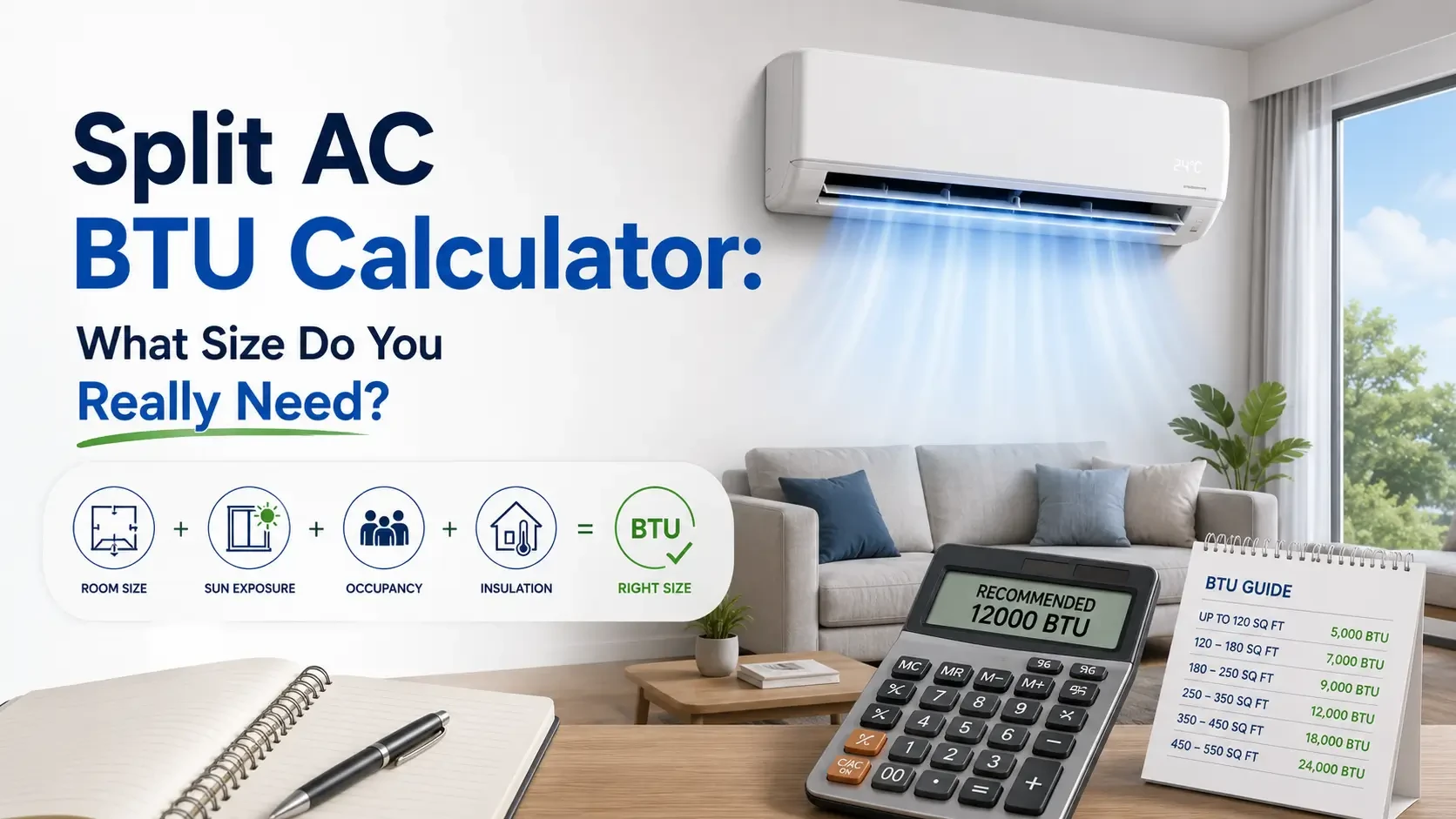
Choosing an air conditioner is rarely about picking the most powerful model on the shelf. It is about matching cooling capacity to the room you actually have. Get it right and your space cools quickly, holds a steady temperature, and runs efficiently for years. Get it wrong and you either struggle through hot afternoons with a unit that never catches up, or you overpay for a system that switches on and off constantly without ever doing its job properly.
The figure at the heart of this decision is BTU. This guide explains what BTU means, how to calculate the size you need, and which type of system fits your space so you can move from guesswork to a confident, accurate choice.
What Is a BTU, and Why Does It Matter?
BTU stands for British Thermal Unit, a measure of energy. In air conditioning, capacity is usually expressed as BTU per hour (BTU/h), which tells you how much heat a unit can remove from a room in an hour. The higher the BTU rating, the more cooling power.
You will also see capacity given in kilowatts (kW). The two are easy to convert: 1 kW of cooling is roughly 3,412 BTU/h. So a common 12,000 BTU split is about 3.5 kW.
The goal is not maximum BTU it is the right BTU. An air conditioner sized correctly for the room is the single biggest factor in comfort and running cost.
The Quick Rule of Thumb
For a first estimate, use cooling demand per unit of floor area:
- Metric: roughly 500–600 BTU per square meter for a standard room with a 2.4–2.7 m ceiling.
- Imperial: roughly 20 BTU per square foot.
Multiply your room area by that figure and you have a baseline. A 20 m² bedroom, for example, lands around 12,000 BTU before any adjustments. This is a starting point, not a final answer real rooms have sun, windows, and people, all of which we account for below.
BTU Sizing Chart by Room Size
Use this chart as a fast reference for standard residential rooms:
| Room size (m²) | Room size (sq ft) | Recommended capacity (BTU/h) | Typical split unit |
|---|---|---|---|
| Up to 12 | Up to ~130 | 9,000 | 9k |
| 12 – 18 | 130 – 195 | 12,000 | 12k |
| 18 – 28 | 195 – 300 | 18,000 | 18k |
| 28 – 40 | 300 – 430 | 24,000 | 24k |
| 40 – 55 | 430 – 590 | 30,000 – 36,000 | 30k–36k or multi-zone |
If your space sits between two rows, or the room has any of the heat-adding features listed in the next section, round up to the next size.
The Factors That Change Your Number
Floor area gets you close, but several real-world conditions push the requirement up or down. Adjust your baseline BTU figure for each that applies:
- Sun exposure: A room with large south- or west-facing windows can need +10%. A consistently shaded room can take −10%.
- Ceiling height: Standard charts assume about 2.5 m. For higher ceilings, add roughly +10–15% for every extra half meter, since you are cooling more air volume.
- Occupancy: Two people are factored in already. Add about +600 BTU per additional regular occupant.
- Kitchens: Cooking adds significant heat. Add around +4,000 BTU for an open or combined kitchen.
- Heat-generating equipment: Servers, multiple computers, or other electronics add load that a simple area calculation ignores.
- Insulation and climate: Poorly insulated rooms, top-floor spaces under a hot roof, and hot regional climates all increase demand.
A Simple Step-by-Step Calculation
Here is the method applied to a real example a 25 m² living room with strong afternoon sun and three regular occupants:
- Base load: 25 m² × 600 BTU = 15,000 BTU
- Sun adjustment (+10%): +1,500 BTU
- Extra occupant (one beyond two): +600 BTU
- Total: ≈ 17,100 BTU
Rounding up to the nearest standard size points clearly to an 18,000 BTU unit. This kind of quick calculation is reliable for most homes; for commercial spaces or unusual layouts, a professional heat-load calculation is worth the investment.
Matching the Number to the Right Type of System
Once you know your BTU target, the next question is what kind of unit delivers it best.
Single rooms: split air conditioners
For one room a bedroom, living room, office, or shop unit a wall-mounted split air conditioner is the standard solution. These systems pair one indoor unit with one outdoor unit and cover the full 9,000–24,000 BTU range that most rooms require. If brand reliability and energy efficiency are priorities, our Mitsubishi Heavy split units and Euroform split range cover the common capacities with strong seasonal performance.
Several rooms, one outdoor unit: multi-split systems
If you need to cool two or more rooms but want to avoid a separate outdoor unit on every wall, a multi-split air conditioner connects multiple indoor units to a single outdoor condenser. Here, you size each indoor unit to its own room's BTU requirement, and the outdoor unit to the combined load. Our Mitsubishi Heavy multi-split systems are a popular choice for apartments and family homes where wall space and exterior aesthetics both matter.
Larger and commercial spaces
When a single room exceeds roughly 40–55 m², or when you are cooling open-plan offices, retail floors, and restaurants, residential splits reach their limit. Professional air conditioning units including ducted, cassette, and floor-standing formats deliver higher capacities while distributing air evenly across a large footprint.
For whole buildings, hotels, and multi-floor commercial projects, a VRF air conditioning system is the scalable answer. VRF lets you connect many indoor units to centralized outdoor units, with each zone controlled independently so BTU sizing becomes a per-zone exercise within one efficient, coordinated system.
Don't forget heating
Most modern split and multi-split systems are reverse-cycle, meaning they heat as well as cool so your BTU calculation also informs winter performance. For homes that want efficient, year-round climate control and hot water, our heat pump systems extend the same principle across the whole property.
Why the Wrong Size Costs You
It is worth understanding why sizing matters so much, because the temptation is always to buy bigger "to be safe."
An undersized unit runs almost continuously, never quite reaching the set temperature on hot days. It wears out faster and uses more electricity for less comfort.
An oversized unit is the more common and more deceptive mistake. It cools the air so quickly that it shuts off before it has removed enough humidity, then restarts moments later. This "short cycling" leaves the room cold but clammy, wastes energy on repeated start-ups, and shortens the compressor's life. Bigger is not better; correctly matched is.
Smart Controls Get the Most From Your System
A right-sized unit performs even better with the right controls. Thermostats, scheduling, and zoning all help maintain a steady temperature instead of swinging between extremes. Our range of air conditioning controllers and accessories from wired controllers to central controllers for multi-zone setups lets you fine-tune comfort and efficiency long after installation.
Final Thoughts
A split AC BTU calculator turns a confusing purchase into a straightforward one: measure your room, apply the per-square-meter rule, adjust for sun, occupancy, ceiling height, and kitchens, then round to the nearest standard capacity. From there, the right type of system split, multi-split, professional, or VRF follows from how many rooms and how large an area you need to cover.
If you would like a precise recommendation for your space, explore the full product range on our homepage or get in touch with our team for a tailored heat-load assessment. The few minutes spent sizing correctly pay back in comfort and lower bills for the entire life of the unit.