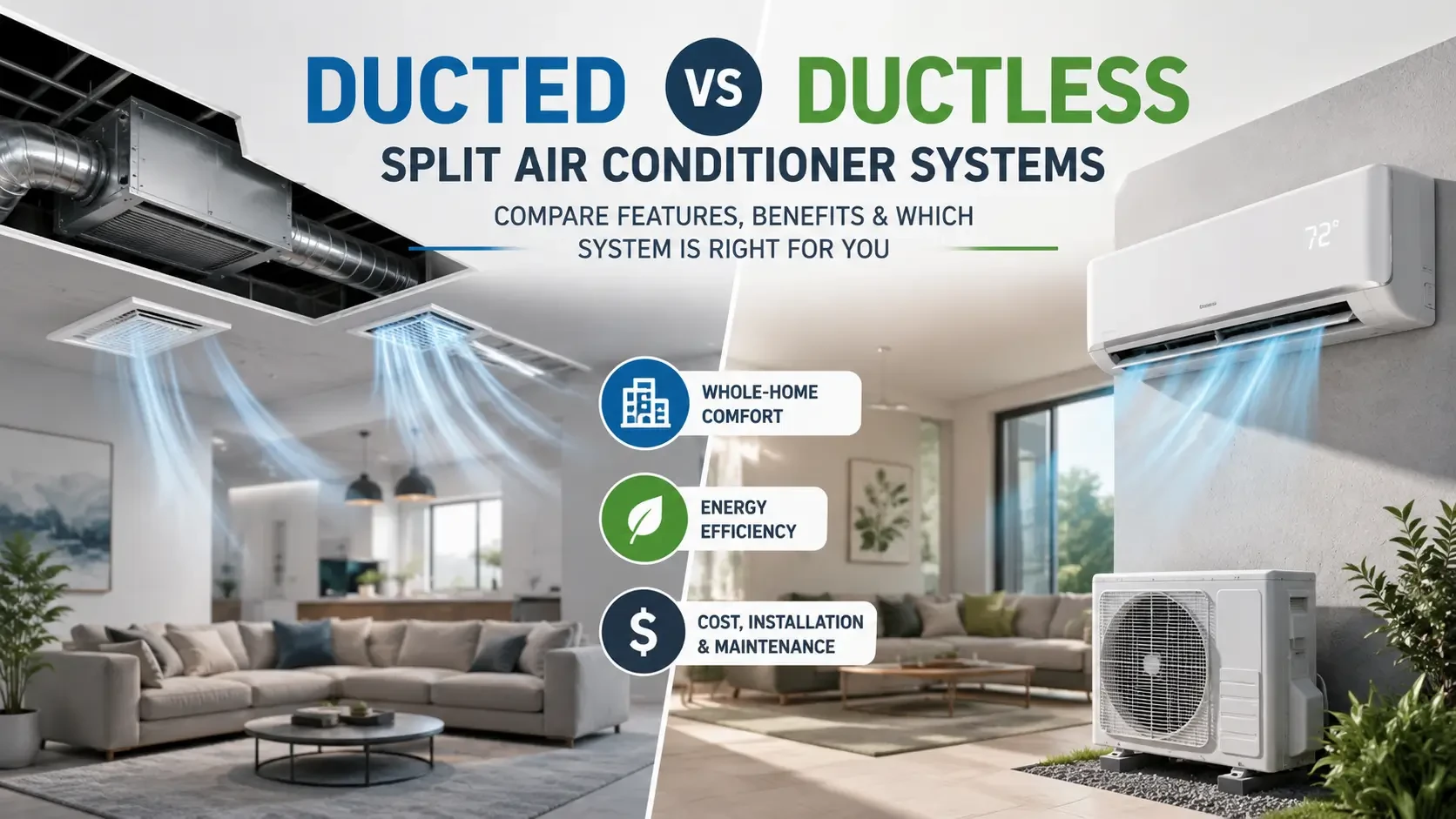
Choosing the right air conditioning system is one of the most important decisions you will make for your home or workplace. Two of the most common options on the market today are single split and multi split systems. They share the same core technology, yet they are built for very different situations. Understanding how they differ in design, cost, installation, and performance will help you invest in a system that fits your space and your budget for years to come.
This guide breaks down both system types in detail, compares them side by side, and helps you decide which one is the better match for your project.
How Split Air Conditioning Works
Every split system is divided into two main parts: an outdoor unit (the condenser) and one or more indoor units. Refrigerant lines, electrical cabling, and a drain pipe connect the two sides through the wall. The outdoor unit handles heat exchange with the outside air, while the indoor unit delivers conditioned air directly into your living or working space.
The word "split" simply refers to this separation between indoor and outdoor components. What changes between system types is how many indoor units are connected to each outdoor unit and that single difference shapes everything from installation complexity to energy use.
If you want to explore the full range of available equipment before diving into the comparison, you can browse our complete collection of split air conditioner systems and multi split air conditioner systems.
What Is a Single Split System?
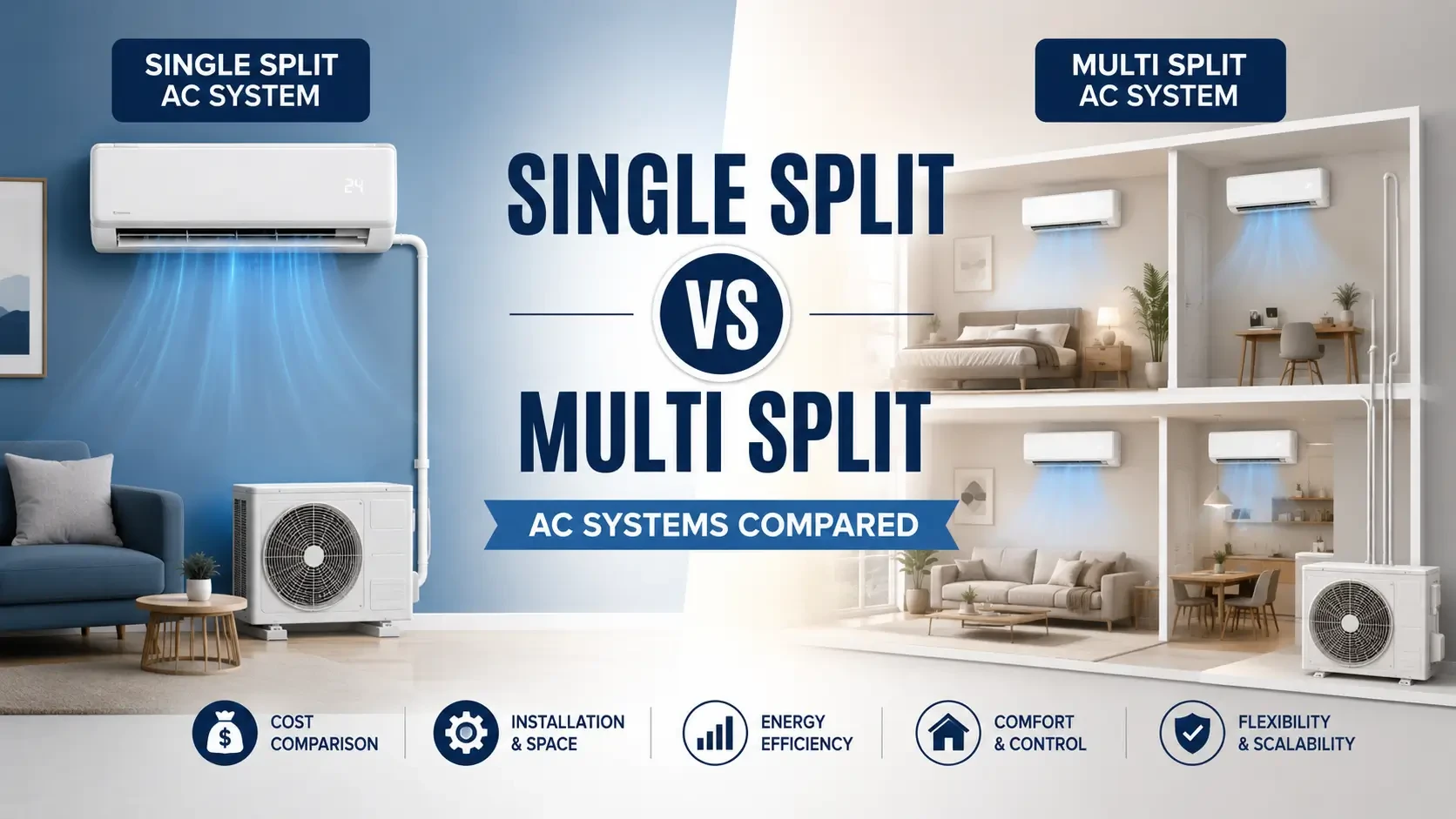
A single split system pairs one outdoor unit with one indoor unit. Each room or zone you want to cool or heat receives its own complete, self-contained system. If you want to condition three separate rooms with single split units, you install three outdoor units and three indoor units.
This is the most straightforward and widely used configuration, especially for individual rooms, small apartments, offices, server rooms, and retail spaces. Because each system operates independently, a fault in one unit never affects another, and replacing a single unit is simple and inexpensive.
Single split units are available in trusted brands and a wide range of capacities. You can review reliable options such as our Mitsubishi Heavy single split units and our Euroform single split range to match the right capacity to each room.
Advantages of Single Split Systems
- Lower upfront cost for a single room or a small number of zones.
- Complete independence each unit runs on its own, so a problem with one never impacts the others.
- Simple installation and maintenance, with shorter refrigerant runs and easier servicing.
- Easy, low-cost replacement when a unit reaches the end of its life.
- Precise per-room control, since every space has a dedicated system.
Limitations of Single Split Systems
- Multiple outdoor units are required when conditioning several rooms, which takes up wall and balcony space.
- More cluttered façades, as each indoor unit needs its own outdoor counterpart.
- Higher cumulative cost once you scale beyond two or three rooms.
What Is a Multi Split System?
A multi split system connects one outdoor unit to multiple indoor units typically between two and five, and in some cases more. A single condenser outside serves several rooms inside, while each indoor unit can usually be controlled and operated independently.
Multi split systems are ideal for homes, apartments, and small commercial spaces where you need to condition several rooms but want to minimize the number of outdoor units. They also allow you to mix indoor unit types wall-mounted, ducted, or cassette on the same outdoor unit, giving you flexibility to match the design of each room.
Our multi split air conditioner range covers a wide variety of configurations, including the high-performance Mitsubishi Heavy multi split systems and the practical Euroform multi split options.
Advantages of Multi Split Systems
- One outdoor unit for several rooms, freeing up valuable balcony, roof, and façade space.
- Cleaner building aesthetics, with fewer condensers visible from outside.
- Independent room control, so each indoor unit can run at a different temperature or be switched off entirely.
- Mixed indoor unit types on a single system to suit different room layouts.
- More cost-effective than several single splits when conditioning three or more rooms.
Limitations of Multi Split Systems
- Higher initial investment than a single unit for one room.
- Shared dependency if the single outdoor unit fails, every connected indoor unit stops working.
- More complex installation, with longer refrigerant runs and careful capacity matching required.
Single Split vs Multi Split: Side-by-Side Comparison
| Factor | Single Split | Multi Split |
|---|---|---|
| Outdoor units | One per indoor unit | One shared by several indoor units |
| Best for | Single rooms, isolated zones | Multiple rooms, limited outdoor space |
| Upfront cost (one room) | Lower | Higher |
| Cost at scale (3+ rooms) | Higher overall | More economical |
| Outdoor footprint | Large with many rooms | Compact |
| Façade appearance | More cluttered | Cleaner |
| Independence | Fully independent units | Shared outdoor unit |
| Installation complexity | Simpler | More involved |
| Replacement | Quick and inexpensive | Affects the shared system |
When Should You Choose a Single Split System?
A single split system is usually the right choice when:
- You only need to condition one room or a single isolated zone.
- Redundancy matters for example, a server room or critical space where you cannot afford every unit failing at once.
- You want the lowest possible upfront cost for a single area.
- The rooms are far apart, making shared refrigerant runs impractical.
For these scenarios, a dedicated unit from our single split air conditioner collection delivers simplicity and reliability.
When Should You Choose a Multi Split System?
A multi split system tends to be the better investment when:
- You need to cool or heat several rooms in the same building.
- Outdoor space is limited and you cannot install multiple condensers.
- Building appearance is important and you want to avoid a wall full of outdoor units.
- You want a single, coordinated system with independent control of each room.
In these cases, exploring our multi split systems will give you the flexibility and cleaner installation you are looking for.
What About Larger Buildings? Beyond Multi Split
Multi split systems have a practical ceiling on the number of indoor units they can support. For larger residential complexes, offices, hotels, and commercial buildings where you may need to condition many zones across multiple floors a VRF (Variable Refrigerant Flow) system is the more scalable solution.
VRF technology connects a large number of indoor units to a single, highly efficient outdoor system, with sophisticated control over each zone and the ability to heat some rooms while cooling others simultaneously. You can learn more about these advanced solutions in our VRF air conditioner category, which includes VRF indoor units, VRF outdoor units, and supporting VRF accessories.
For commercial premises with heavier demands, our professional air conditioning systems are designed to handle higher capacities and continuous operation.
Control and Accessories Make the Difference
Whichever system you choose, the right control equipment improves comfort and efficiency. Modern split and multi split systems can be paired with smart and centralized controls that let you manage temperatures, schedules, and energy use with precision.
If you want to manage several units from one point, our central controllers and wired controllers are worth considering. You can also browse the full range of air conditioning accessories to complete your installation.
Conclusion: Which System Is Right for You?
The choice between single split and multi split comes down to how many rooms you need to condition and how much outdoor space you have.
Choose a single split system when you need to cool or heat one room, want the lowest entry cost, or require fully independent units. Choose a multi split system when you have several rooms to serve, limited outdoor space, and want a cleaner, coordinated installation. For larger buildings, a VRF system takes that scalability even further.
If you are still unsure which configuration suits your space, the best starting point is to compare capacities and models across our single split and multi split ranges or get in touch with our team for tailored guidance based on your specific project.