Choosing the right cooling system is one of the most important decisions you will make for your home or workplace. For decades, the conversation has come down to two familiar options: the window air conditioner and the split air conditioner. Both will cool a room, but they do so in very different ways, and the right choice depends on your space, your budget, and how much comfort and efficiency you expect over the long term.
This guide breaks down how each system works, where each one excels, and how to decide which is genuinely the better fit for your needs.
What Is a Window Air Conditioner?
A window air conditioner is a single, self-contained unit that houses every component compressor, condenser, evaporator, and fan inside one box. It is mounted directly into a window opening or a hole in an exterior wall, with the back half releasing heat outdoors and the front half blowing cool air into the room.
Because everything sits in one enclosure, installation is straightforward and the upfront cost is low. These traits have kept window units popular for small apartments, single rooms, and temporary setups. The trade-off is that the entire mechanism including the noisy compressor sits inside your living space.
What Is a Split Air Conditioner?
A split air conditioner separates the system into two parts: an indoor unit that delivers cool, filtered air, and an outdoor unit that contains the compressor and condenser. The two are connected by refrigerant lines and electrical wiring that run through a small hole in the wall.
This separation is the key to almost every advantage a split system offers. By moving the loud, heat-generating components outside, the indoor unit stays quiet, slim, and discreet. Modern split air conditioners also use inverter technology to adjust their output continuously, delivering steady comfort while consuming far less energy than older fixed-speed designs. Premium options such as our Mitsubishi Heavy split systems pair this efficiency with advanced filtration and precise temperature control.
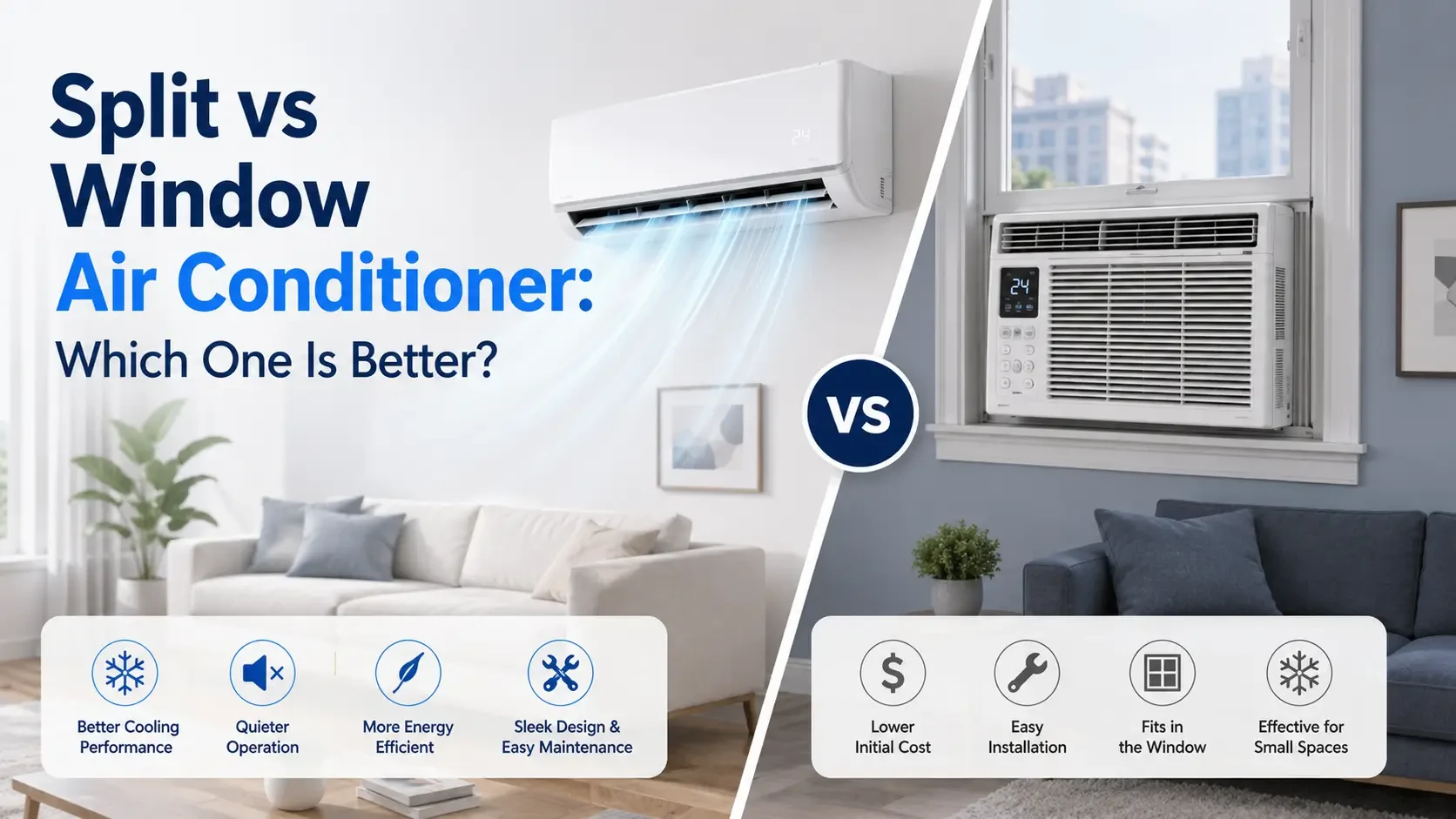
Key Differences at a Glance
| Feature | Window Air Conditioner | Split Air Conditioner |
|---|---|---|
| Installation | Simple, fits in a window | Professional install, wall-mounted |
| Noise level | Higher (compressor indoors) | Very low (compressor outdoors) |
| Energy efficiency | Moderate | High (inverter technology) |
| Aesthetics | Bulky, blocks window | Slim, low-profile indoor unit |
| Cooling capacity | Best for small rooms | Small rooms to large multi-zone spaces |
| Upfront cost | Lower | Higher |
| Long-term value | Lower efficiency, shorter lifespan | Higher efficiency, longer lifespan |
Installation and Placement
A window unit only needs a suitable window or wall opening and can often be installed by the owner in an afternoon. That convenience comes with a catch: it permanently occupies a window, blocking light and the view, and it is limited to rooms with the right opening.
A split system requires professional installation to mount the indoor unit, run the refrigerant lines, and position the outdoor unit. While this adds to the initial effort, it frees you from depending on a window and gives you complete flexibility in where the unit is placed for the best airflow.
Cooling Performance and Capacity
For a single small room, a properly sized window unit cools effectively. But its capacity is finite, and it struggles to serve larger or open-plan spaces.
Split systems scale far more gracefully. A single indoor unit can comfortably handle a large living room, and when you need to cool several rooms at once, the technology grows with you. A multi-split air conditioner connects multiple indoor units to one outdoor unit, letting you control each room independently without cluttering every wall with separate condensers. For larger residences, offices, and commercial buildings, a VRF air conditioning system takes this further, balancing cooling and heating across dozens of zones from a single, highly efficient outdoor system.
Energy Efficiency
Energy efficiency is where the gap between the two is widest. Most window units run at a single speed, switching fully on and off to maintain temperature, which wastes energy and causes temperature swings.
Inverter-driven split systems modulate their compressor speed to match the exact cooling load, avoiding the constant start-stop cycle. Over a hot season, that difference shows up clearly on your electricity bill. For businesses and large facilities where running costs matter most, professional air conditioning systems are engineered specifically to deliver high capacity with minimal energy waste.
Noise Levels
Since a window unit keeps its compressor inside the room, a noticeable hum is unavoidable. In a bedroom or quiet office, that constant sound can become a real distraction.
A split system places the compressor outdoors, so the indoor unit produces little more than a soft whisper of moving air. This alone is reason enough for many people to choose a split system in bedrooms, nurseries, and study spaces.
Aesthetics and Space
Window units are bulky and protrude from the building, both inside and out. They commit a window to the air conditioner and rarely blend into a room's design.
Indoor split units are slim, modern, and mounted high on a wall or recessed into a ceiling, taking up no usable floor or window space. For anyone who cares about how a room looks, the difference is significant.
Cost: Upfront and Long-Term
There is no denying that a window air conditioner wins on initial price. If your budget is tight and you only need to cool one small room temporarily, it is the cheaper way in.
A split system costs more to buy and install, but it usually earns that money back. Lower energy consumption, longer equipment lifespan, and better comfort mean the higher upfront investment often becomes the more economical choice over the years.
Beyond Cooling: Year-Round Comfort
One advantage that window units rarely offer is efficient heating. Many modern split systems double as heat pumps, providing warmth in winter as effectively as they cool in summer. If you want a single solution for the whole year, a dedicated heat pump system delivers efficient heating and hot water alongside cooling, replacing the need for separate appliances.
Smart Controls and Customization
Split systems also integrate easily with modern control options, from precise wall thermostats to centralized management for multiple units. Adding the right central controllers and accessories lets you schedule operation, manage several zones from one place, and fine-tune comfort room by room something a basic window unit simply cannot match.
The Verdict: Which One Is Better?
If you need to cool a single small room on a minimal budget for a short period, a window air conditioner does the job and costs less to start.
For nearly every other situation quieter operation, lower running costs, better looks, flexible placement, year-round comfort, and the ability to cool one room or an entire building the split air conditioner is the clear winner. It is an investment that pays back in comfort and efficiency for many years.
If you are ready to upgrade your space, explore our full range of split and multi-split air conditioning solutions to find the system that fits your home or business perfectly.